
Sounding Spomenik #6: Čačak – Milana Zarić
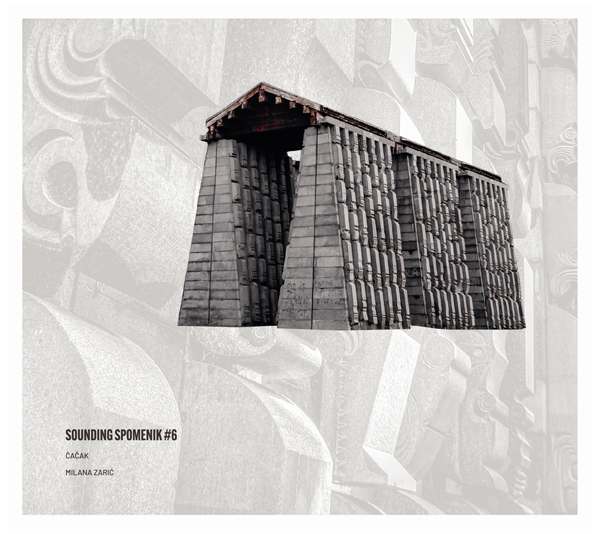
1. Alignment (3:51)
2. Field Recording: Short Axis, Facing South-West (Forest) (5:00)
3. Granite Ghosts (7:28)
4. Field Recording: Short Axis, Facing North-East (City Centre) (5:00)
5. Hypnostinato (5:10)
6. Field Recording: Long Axis, Facing North-West (5:00)
7. Mythologemes (7:45)
8. Field Recording: Long Axis, Facing South-East (5:00)
9. Dialogue (7:46)
· Milana Zarić: harp / harfa
All music by / glasba: Milana Zarić (SOKOJ)
Field recordings by / terenski zvočni posnetki: Jernej Babnik Romaniuk
Recorded in Čačak, Serbia on 24 July 2024 / posneto v čačku, srbija, 24. julija 2024
Recorded, edited, mixed and mastered by / snemanje, oblikovanje zvoka: Jernej Babnik Romaniuk
Liner notes by / spremna beseda: Milana Zarić & László Juhász
Photos by / fotografije: László Juhász & Jernej Babnik Romaniuk
Graphic design by / oblikovanje: Iringó Papdi-Pécskői
Executive producer / izvršni producent: László Juhász
Associate producer / producentka: Nataša Serec
Special thanks to / posebna zahvala: Richard Barrett, Culture Moves Europe, Goethe-Institut, Udruženje harfista i prijatelja harfe Srbije, Grad Beograd & SOKOJ
Introduction
While the striking and still enigmatic appearance of the abstract brutalist monuments of the former Socialist Federal Republic of Yugoslavia has been well-documented in recent years, we know hardly anything about their sounding aspects. Most of these spomeniks (original plural form spomenici, meaning memorials in the Serbo-Croatian language, derived from the root spomen- which means memory) have hollow parts that serve as resonant spaces. The most characteristic materials from which these historical artefacts were made are poured concrete and rebar, or steel frames with metallic covering plates, all materials that certainly influence sounds or can modify them audibly. Curiously, nobody has until now examined, thoroughly documented and published these enduring landscape objects as acoustic spaces. Besides the spomeniks’ direct sonic aspects, we know little about their surrounding acoustic environments. The majority of these unique and individual monuments were constructed in remote rural locations, usually far from any urbanization, while some of them were erected in city centres or suburbs, or near villages – all of which give rise to a highly diverse range of sounding ambience.
However these spomeniks functioned – and some of them still function – as World War II memorials with a clear anti-fascist connotation, and from the mid-50s until the late 70s as the materialized emblems of Josip Broz Tito’s utopian idea of a strong and united Yugoslavian state with the slogan ‘brotherhood and unity’, we regard these abstract but undisputedly iconic modernist constructions primarily as architectural works of art. These monuments, rooted in the anti-fascist struggle and commemorating countless victims of oppression, carry deep historical and ideological weight. We approach them with respect for their historical significance and as reminders of the fight against fascism. As a record label, we are interested in exploring their layered histories, but our primary focus lies in uncovering and amplifying the unique sonic qualities embedded within these monumental structures.
In 2021, Inexhaustible Editions sublabel SonoLiminal initiated a long-term research, recording and publishing project to explore and reveal the sonic attributes of spomeniks of the former Yugoslavia (which can now be found in Slovenia, Croatia, Bosnia and Herzegovina, Serbia, Montenegro, Kosovo, and North Macedonia) by asking local instrumentalists – mainly young and remarkably talented professional musicians working locally or internationally in the fields of free improvisation or contemporary composed music – to play sounds on-site, and to find the most responsive or fascinating sounding parts of the monuments. Besides the intentional sounds produced by musical instruments, we intend also to document the unintentional sounds of the immediate surroundings via environmental recordings. Each year we plan to visit, examine and reflect on at least three or four monuments through field trips, recording sessions and, eventually, audio publications. Until now we have gathered more than twenty locations with emblematic spomeniks which are relevant to our Sounding Spomenik project.
László Juhász
April 2021
Večito
The Mausoleum of Struggle and Victory, one of the prime examples of commemorative architecture in Yugoslavia, was designed by Bogdan Bogdanović and realized in 1980, on a hill next to the Serbian town of Čačak, where it still stands today. The memorial complex to the fallen fighters who defended Čačak against the German occupation in WWII has at its centre a 12 metre tall triple megaron monument of stone and wood, adorned with 620 carved heads of mythological beasts. It has been suggested that it symbolically represents a portal taking visitors on a journey to the afterlife, while at the same time it is clearly an open gateway, resonating with the environment, visually as well as audibly.
I was invited by the Sounding Spomenik team as both composer and performer to contribute to its sonic reanimation and reinterpretation for the present day.
While imagining the acoustic space in and around this imposing structure, as well as meaning of revisiting it after years of neglect in the post-Yugoslav era, I came across a quote from the architect Bogdanović, who said that his concern was not about what was modern and what was not, but what was večito (perpetual, eternal, endless). This struck a chord in terms of possible connections with my own musical background. The initial impulse was to convey resonating parallels between my instrument, the harp, an ancient instrument capable of conveying labyrinthine layers of sound, detached from the concerns of modernity and the contemporaneous – and the ideas behind the creation of this particular spomenik.
I devised a special detuning system for the harp, intertwining layers of ostinato lines, enabling my instrument to produce a ‘wall of sound’ in correspondence with the surrounding architecture and the multiplicity of lives commemorated there, but also in communication with its natural, outdoor, open environment. This concept was realized through a diversity of timbres and instruments. In the track Granite Ghosts, layered voices respond to the idiosyncratic mythology of the aforementioned carved heads, which are placed asymmetrically on the sides of the stone gates, symbolizing perpetual, endless, nameless voices of lives lost and past.
At the location itself, my pre-imagined processes became a tangible reality, as the blueprints for the pieces finally took a definitive performative shape. Adding to the instrumental performance, further layering processes were set in motion, by a whole array of environmental sounds captured by the recordings.
The first thing we encountered when we arrived to the memorial in July 2024 was a wall of heavy rain, which prevented us from taking immediate action. We listened to the sound of the rain for several long hours before we could climb up the hill where the monument stands. The field recordings of this rain, which was so persistent and uncompromising, together with corresponding sounds of crows and wildlife, formed an essential part of the resulting material presented in this album.
Furthermore, listening to these sounds became an essential part of the construction of the music throughout the performance, which is especially evident in the dialogue between the percussion and the sounds of the nearby nature and faraway traffic and city.
This album, representing a journey from my own compositional concept, aligned with the concept of Sounding Spomenik’s series of recordings, to improvisatory material, momentary interactions and the captured sounds of the location, is intended to bring forth the audible presence of the Mausoleum of Struggle and Victory as part of our collective cultural heritage from now on.
Milana Zarić
March 2026
Releases: December 2026 / first edition of 300 cds
Direct purchase: Bandcamp / Discogs
REVIEWS ↓
RADIO PLAYS ↓