
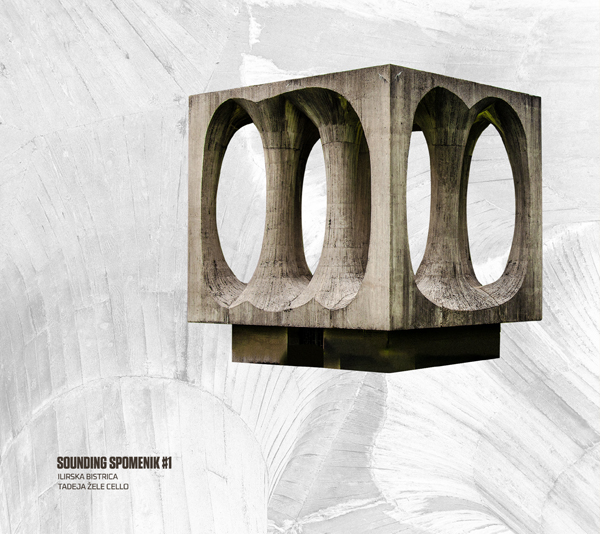
Sounding Spomenik #1: Ilirska Bistrica – Tadeja Žele
1. Underneath, In The Crypt (12:00)
2. Field Recording: Facing South-West (Industrial Zone) (5:00)
3. Field Recording: Inside / Underneath (5:00)
4. Alongside, Against The North-West Side (8:30)
5. Field Recording: Outside / Atop (5:00)
6. Field Recording: Facing North-East (Town Centre) (5:00)
· Tadeja Žele: cello / violončelo
All music by / glasba: Tadeja Žele
Field recordings by / terenski zvočni posnetki: Jernej Babnik Romaniuk
Tracks 2, 3, 5, 6 recorded in Ilirska Bistrica, Slovenia on 29 May 2021 / skladbe 2, 3, 5, 6 posnete v Ilirski Bistrici, Slovenija, 29. maja 2021
Tracks 1, 4 recorded in Ilirska Bistrica, Slovenia on 3 August 2021 / skladbi 1, 4 posneti v Ilirski Bistrici, Slovenija, 3. avgusta 2021
Recorded, edited, mixed and mastered by / snemanje, oblikovanje zvoka: Jernej Babnik Romaniuk
Liner notes by / spremna beseda: Borut Savski & László Juhász
Photos by / fotografije: László Juhász & Jernej Babnik Romaniuk
Graphic design by / oblikovanje: László Szakács
Executive producer / izvršni producent: László Juhász
Associate producer / producentka: Nataša Serec
Special thanks to / posebna zahvala: Borut Savski, Roberto Truzzardi, Stanislav Zver & TIC Ilirska Bistrica
Introduction
While the striking and still enigmatic appearance of the abstract brutalist monuments of the former Socialist Federal Republic of Yugoslavia has been well-documented in recent years, we know hardly anything about their sounding aspects. Most of these spomeniks (original plural form spomenici, meaning memorials in the Serbo-Croatian language, derived from the root spomen- which means memory) have hollow parts that serve as resonant spaces. The most characteristic materials from which these historical artefacts were made are poured concrete and rebar, or steel frames with metallic covering plates, all materials that certainly influence sounds or can modify them audibly. Curiously, nobody has until now examined, thoroughly documented and published these enduring landscape objects as acoustic spaces. Besides the spomeniks’ direct sonic aspects, we know little about their surrounding acoustic environments. The majority of these unique and individual monuments were constructed in remote rural locations, usually far from any urbanization, while some of them were erected in city centres or suburbs, or near villages – all of which give rise to a highly diverse range of sounding ambience.
However these spomeniks functioned – and some of them still function – as World War II memorials with a clear anti-fascist connotation, and from the mid-50s until the late 70s as the materialized emblems of Josip Broz Tito’s utopian idea of a strong and united Yugoslavian state with the slogan ‘brotherhood and unity’, we regard these abstract but undisputedly iconic modernist constructions primarily as architectural works of art. These monuments, rooted in the anti-fascist struggle and commemorating countless victims of oppression, carry deep historical and ideological weight. We approach them with respect for their historical significance and as reminders of the fight against fascism. As a record label, we are interested in exploring their layered histories, but our primary focus lies in uncovering and amplifying the unique sonic qualities embedded within these monumental structures.
In 2021, Inexhaustible Editions sublabel SonoLiminal initiated a long-term research, recording and publishing project to explore and reveal the sonic attributes of spomeniks of the former Yugoslavia (which can now be found in Slovenia, Croatia, Bosnia and Herzegovina, Serbia, Montenegro, Kosovo, and North Macedonia) by asking local instrumentalists – mainly young and remarkably talented professional musicians working locally or internationally in the fields of free improvisation or contemporary composed music – to play sounds on-site, and to find the most responsive or fascinating sounding parts of the monuments. Besides the intentional sounds produced by musical instruments, we intend also to document the unintentional sounds of the immediate surroundings via environmental recordings. Each year we plan to visit, examine and reflect on at least three or four monuments through field trips, recording sessions and, eventually, audio publications. Until now we have gathered more than twenty locations with emblematic spomeniks which are relevant to our Sounding Spomenik project.
László Juhász
April 2021
Cavities as bodies inverted to within
Cavities are strange creatures. At first, they can be perceived as emptinesses, but soon we can see them as bodies. However, a left/right recording is two-dimensional. Like a painting. A representation of a three-dimensional body. The view presented here is of a cavity as an inverted body – as an active partner in sound –, an instrument.
Sound travels at about 340 meter per second, going from the source outwards until energy lasts, but when within a cavity the sound bounces from the walls – we perceive it as a very structured acoustic space, a resonating space. Not only is the sound bouncing – creating an echo effect – but it also acts as a frequency filter/amplifier for the frequencies with wavelengths close to the dimensions of the cavity. Cavity is a natural sound amplifier. I use the word “cavity” for the hollow “body”. The word “body” is crucial. A resonating (hollow) body is perceived from the outside, while the cavity is perceived from the inside. Both are potentially resonating bodies. Sound without a resonating body is boring – no identity, no interpretation –, a manifestation only.
Since cavity is a body inverted to within – the surface (skin) is on the inside. In case of simplified organic-like insides (like the multiple elliptoid cavity body of the monument in Ilirska Bistrica representing the symbolics of underground water-dug caverns, typical for the area), the sound identity is unique – but far from complex. Complexity comes from irregularities. Complexity is also a precursor of chaos (and noise) – it lessens the prevalent effect in favor of a more statistical uniformity. The openness of cavities to the outside also limits the effectiveness of a closed resonating space.
Each cavity creates its unique spectral and echo identity. It is a unique identifier based on physical/material properties and dimensions of the “inner space”. As such, it is an instrument. A musician with a musical instrument enters the body and makes its acquaintance through sound. Testing this and that – and getting the result. The experience of innersides is wholesome – it is physical. Acquaintance is rewarding if the bounced-back and amplified result is sound-wise gratifying. For this, a musician has to adapt his/her playing of his/her instrument to that of the hosting resonating body. It is only then that the two instruments’ identities can enter into communication: the conflicting situations when the two instruments can get clearly identified as separate subjects.
While mentioning the subject, an additional metaphor using sound and resonating body comes from Anthony Gritten who describes the process of listening as opening (the mind) to incoming sound (or a word) and proactively using such an open (hollow) mind to allow the sound to resonate in it. Resonating in this manner is an additive or even multiplying process, which he describes as a process of rhythm – this being synonymous with giving the sound a notion of sense and meaning – and consequently the realisation of the subject (the open mind) as the generator of the (cognitive) process.
Opening/emptying of the space/mind is creating a cavity where ideas/sounds can be positioned/repositioned in a variety of ways. As already mentioned, it is a process of cognition. The more passive the cavity, the more cognitive process is demanded from the part of the musician to make the cavity resonate/play.
Decision to have a musician with his/her instrument enter a resonating cavity as an additional instrument is a conceptual one. It is necessary to observe it as a unique system. The musician must accept this fully – any old music just won’t do. It is a unique opportunity. Accepting the situation is adapting to the outer limitations. What kind of music will it be?
Borut Savski
July 2023
Released: November 2024 / first edition of 300 cds
Direct purchase: Bandcamp / Discogs
REVIEWS ↓
RADIO PLAYS ↓